Category: Real Estate (20)

5 retro baches for sale where you can live the quintessential Kiwi dream

Article by HOMES TO LOVE

5 retro baches for sale where you can live the quintessential Kiwi dream

There is naught more quintessentially ‘kiwi’ than humble New Zealand baches. The Kiwiana bach is one filled with mismatched furniture, board games, and rowdiness – here are a few of our favourite picks that fit the bill currently on the market around the country.

1. Classic Kiwi Beach Bach – Dunedin

In a woodland setting overlooking beautiful Blueskin Bay just out of Dunedin, this home certainly does not lack in character. This funky three bedroom house offers a great place to get out of the city and retreat away from the hustle and bustle of the city.

With a clear ’80s theme – the bold carpet and lime green exterior isn’t for everyone, so this may be a DIY dream. There are multiple opportunities to enhance this property and make it your own if you’re looking for a special getaway.

More information 

2. A taste of Kiwiana – Christchurch 

Located 30 minutes out of Christchurch in the small rural community of Springston, this kiwi bach may be your idea of a great place to enjoy a quiet weekend away. ‘Character’ is the opulent word here, and it certainly isn’t perfect – but that’s part of the charm. The bright yellow and green painted joinery are nods to trends of past architectural eras, and the rest of the home is full of similar vintage gems.

The retro colour scheme is visible throughout the home, including the bold blue coloured bathtub with matching curtains.

The clear 1980’s decor theme is evident in the bold mish-mash of patterns, there is certainly no shortage of floral bedding in this home. If you love this look – you’re in luck, the owner has enjoyed his time here and is willing to leave it to the new owners with all the bach necessities. He is also considering offers from $99,000 so the price is definitely right.

More information 

3. Serenity on The Sounds – Marlborough Sounds

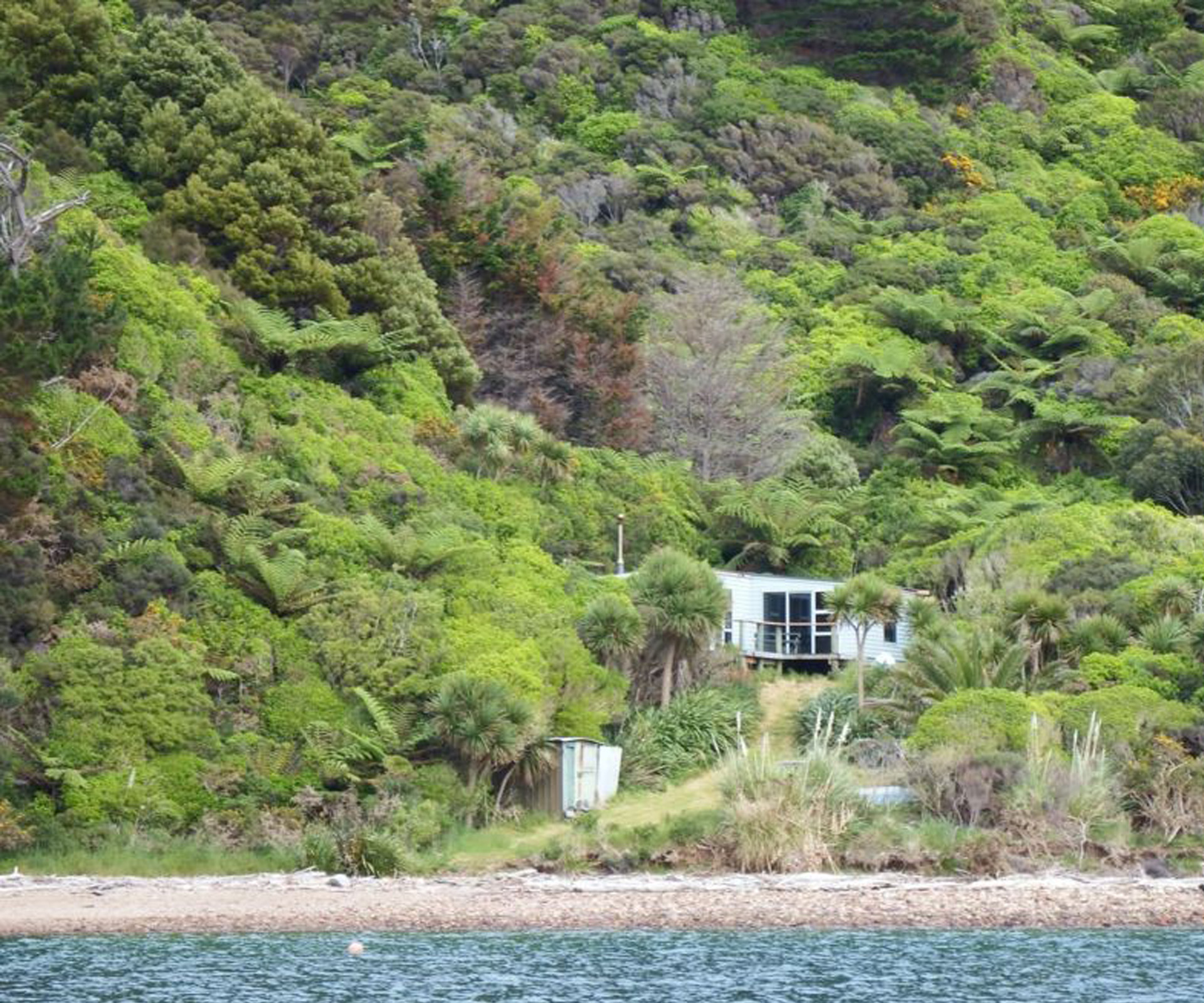
This place is not for the faint-hearted – but fortune favours the bold. Only accessible by boat and run entirely on solar power, it may feel more like camping than a beach house, but the undisturbed views of the remarkable Marlborough Sounds will make it all worth it. In one of the most beautiful parts of the country, you will never tire of this scenery – which you can enjoy from your ‘Poor Man’s’ hot tub!

If you wish to complete home improvements – the building equipment is already on site for you to create your own private sanctuary. This is an opportunity to create the ultimate Kiwi bach waterfront property, with 1.2 hectares of north facing native bush and great water supply.

The house might require some love, but the bones are there and the location is unbeatable.

More information 

4. Entry Level Bach – Little Sunny Bay 

This little gem encompasses all the things I love about the quintessential Kiwi bach. The bedrooms are small, and all the attention has been placed on the deck – where all your time here will be spent. The cute little cottage, which is perched close to popular Little Sandy Bay makes the ultimate tranquil getaway.

With four bedrooms, a lounge and a large outdoor area there is space for everyone, and this is a great place for entertaining.

The house is tidy and presents an exciting buying opportunity for a lucky person wanting a remote Coromandel getaway.

More information 

5. Rustic Retreat – Lawrence 

This is the ultimate quirky South Island getaway. Filled with interesting knick-knacks and antiques, the furniture is included so you won’t have to work hard to make this unique property a home.  If you don’t want to live here – make it your secluded lock-and-leave getaway and a great base to enjoy much of what the South Island has to offer.

Only a 30-minute drive from Dunedin Airport, you will feel a world away in this native bush surrounded area. The upstairs has a generous open-plan living and kitchen area while the rest of the house offers three bedrooms and a character-filled bathroom.

There are opportunities galore at this stunning retreat in the wilderness!

More information 

Words by: Kate Milliken Photos via: Realestate.co.nz
Expert advice on how to make a small kitchen work

On a one-wall kitchen it's a good idea to have another surface to act as extra bench space. This could be a small table or an island on wheels.
JANE USSHER
On a one-wall kitchen it’s a good idea to have another surface to act as extra bench space. This could be a small table or an island on wheels.

Sometimes “too many cooks in the kitchen” can literally mean the kitchen is too small for the cooks.

But, “a compact space doesn’t mean culinary dreams should be discarded,” says kitchen designer Toni Roberts of Kitchen Architecture Ltd. Here’s how to make a small kitchen space as big as possible:

LAYOUT

When designing a small kitchen, layout is vitally important says Roberts. “The secret is understanding the dynamics of a kitchen’s workflow.”

She calls it “activity zoning.” Where will each task be done and what does each part needs in terms of storage, shelving, draws and lights? But also when might it be used by people at different times of the day? These are all questions to ask to ensure a small kitchen is as functional as possible.

Interior designer Nicola Manning suggests the best layout for a small kitchen is a galley style, which normally features two parallel walls with the kitchen benches, cabinets and storage on either side.

Keep clutter off the bench, a knife rack on the wall or in a drawer is a good idea.
JANE USSHER/NZ HOUSE AND GARDEN
Keep clutter off the bench, a knife rack on the wall or in a drawer is a good idea.

“This means you don’t have any awkward corners to work with and gives you full access to all part of the kitchen,” she says.

A one-wall kitchen is compact and space-saving but it can lack in bench space. Install a kitchen island trolley on wheels, it will provide the extra bench space needed for food prep and can be rolled away and stored when it’s not being used.


STORAGE AND SHELVING

“Every centimetre of a small kitchen must be utilised to it’s full extent,” says Manning.

She suggests taking overhead and full height cupboards all the way to the ceiling. Use the toe-kick space under the cupboards as storage for platters or trays and full extension internal drawers within cupboards maximise quantity of storage.

In a small kitchen space is at a premium, create a bar like this so people can work either side of the bench.
JANE USSHER
In a small kitchen space is at a premium, create a bar like this so people can work either side of the bench.

Shelving could be your key to keeping clutter off the bench. Even if it’s just a simple shelf or ledge on the wall, it’s the perfect spot for all those frequently used items that tend to hang around on the bench; oil, salt and pepper, tea canisters, herbs and spices.

THE BENCH

“Most would think to fill a small kitchen design with as much bench space as possible,” says Roberts. “But it’s more about proportions and the intended functionality.”

The toe-kicker space beneath cabinets is the perfect place to add a slim drawer to store trays and platters.
JANE USSHER
The toe-kicker space beneath cabinets is the perfect place to add a slim drawer to store trays and platters.

When Roberts designs small kitchens she usually ensures there are at least two bench zones for food prep and plating up and an additional zone for drink making.

Manning suggests using a sink that has accessories such as a chopping board that can fit over top, or simply a sink cover to increase bench space.

An induction stove is also a better option than a gas stove as it provides more flat surface that can be used as bench.

Keeping bench space clear is vital when you don’t have much space to begin with, so Manning suggests building the microwave into the wall instead of having it sit on the bench. Incorporate a knife block into a cutlery drawer so there isn’t need for a knife block on the bench either.

And while we’re tucking things away, it’s best to create an ‘appliance garage;’ a cupboard that houses the toaster, kettle, coffee machine and blender on the bench, but has doors to hide it away if need be.

COLOUR

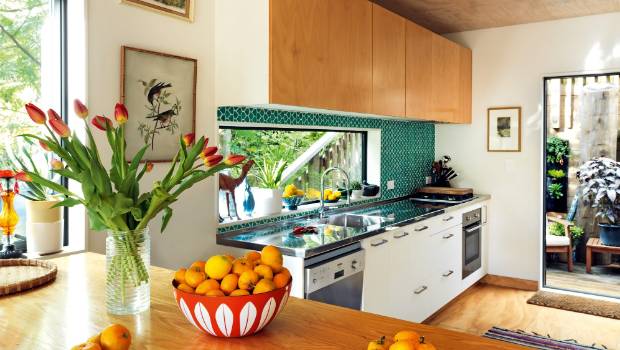
Lighter colours in a smaller kitchen will make the space feel bigger, but add some other texture and colour for personality and to prevent it from being too sterile.
JANE USSHER / NZ HOUSE & GARDEN
Lighter colours in a smaller kitchen will make the space feel bigger, but add some other texture and colour for personality and to prevent it from being too sterile.

Light colours will make a space feel bigger and making your cabinetry and walls the same colour will create a visually larger space.

“The only caution is that this might create a soulless kitchen,” says Roberts. “Balance this risk with the use of texture and colour.”

LIGHTING

If you can, take cabinets all the way up to the ceiling to maximise storage.
CATHERINE GRATWICKE
If you can, take cabinets all the way up to the ceiling to maximise storage.

Choose a lighting layout that will make the ceiling feel taller and the corners of the room softer, this will create the illusion of more space.

“Natural and auxiliary lighting will give the appearance of space and openness,” says Roberts.

Luxury Train Journey Through New Zealand

By David Loughrey  Otago Daily Times

These railway carriages will be refurbished in Dunedin for a luxury New Zealand train service. Photo: Stephen Jaquiery

These railway carriages will be refurbished in Dunedin for a luxury New Zealand train service. Photo: Stephen Jaquiery


The company behind a planned luxury train journey through New Zealand will use Hillside Workshops in Dunedin to refurbish its carriages.

The arrival of the carriages is the first sign plans released by the company late last year for a luxury train journey through regional New Zealand are coming to fruition.

Yesterday, Antipodean Explorer confirmed it owned 16 carriages that turned up recently on a siding near Forsyth Barr Stadium.

It also confirmed they would be refurbished at the Hillside site that closed amid controversy in 2012.

While details were sparse last night, it is understood the company has leased space at Hillside to carry out the work.

In December, Antipodean Explorer NZ co-founder and general manager Amanda Johnston announced the journey, to be pitched at wealthy tourists, would run from Auckland and travel through provincial New Zealand, including Dunedin and Invercargill.

There were also plans for road excursions, with the company intending to offer trips to Queenstown.

The train would have 16 carriages, and the company had bought 31 that had been used in Auckland.

Mrs Johnston, of Auckland, said at the time she hoped the carriages, which would be kitted out as “a moving hotel”, would be refitted at Hillside.

Dunedin had been chosen for the work as there were not many places 31 carriages could be stored and worked on at one time.

The company had financial backing from Chinese company Fu Wah.

Yesterday, Mrs Johnston told the Otago Daily Times the 16 former commuter train carriages had arrived in Dunedin from Taumaranui.

Over the next two years, these 16 carriages will be refurbished at the Hillside engineering workshop in South Dunedin into a luxury sleeper train aimed at high-value visitors from around the world, including the US, Europe, Asia and Australia.”

Antipodean Explorer had bought 31 carriages with the long-term intention of having two trains in operation – one in the North Island and one in the South Island.

Mrs Johnston said the former Auckland suburban carriages had not been used for some years, and had been sitting on a railway siding in Taumarunui.

KiwiRail had been commissioned to haul them from Taumarunui to South Dunedin.

This is an exciting step for the company,” she said.

Once the work at Hillside was completed, the service was planned to begin in early 2020.

The company had an agreement with KiwiRail to access its rail network.

Dunedin South MP Clare Curran said it was “very good news”.

Her understanding was the company had leased at least one building at Hillside and was “intent on going ahead”.

There was support building to rejuvenate Hillside, she said.

Dunedin City Council economic development business relationship manager Des Adamson said he had been providing assistance to Antipodean Explorer since the initiative was announced early in December.

That had included providing information on the capacity of the city’s engineering sector.

Dunedin Railways had also been involved.

Mr Adamson said if the project came to fruition it would provide benefits to Dunedin businesses.

A spokeswoman for Bradken, which works from a site at Hillside, said the company was not involved in the project.

Regional New Zealand flourishes in current property market, while the main centres stall.

Download the New Zealand Property Report as a print-ready PDF. 

Regional New Zealand outshone the main metropolitan centres in March, based on latest statistics released by realestate.co.nz, New Zealand’s largest property listing site.

“The regions are looking lively with asking prices and new listings up in most of the country’s regions, while the main centres paint a different picture,” says Vanessa Taylor, spokesperson for realestate.co.nz.

Real-time statistics from realestate.co.nz show that the top 10 regions with the largest increases in asking prices (compared to the prior month), did not include any of the main centres.

“When we drill down to the top five and bottom five regions, the picture becomes even more interesting.”

Vanessa Taylor says there are opportunities in both sectors.

“In the regions where the market is lively, it represents choice for both buyers and sellers, wherever they are on the property ladder.

“In some regions, such as Auckland, a fall in asking prices could result in renewed opportunities for buyers, including those who want to move up the property ladder.”

Average Asking Price Map March 2018

The five top “hot regions” 

The top five “hot regions” are Gisborne, Northland, Marlborough, Coromandel and Hawke’s Bay (respectively).

All five regions recorded more than a 3.5% increase in asking prices (compared to the previous month) as well as a healthy lift in the number of new listings (compared to March 2017).

Gisborne topped the March table with a 14.5% increase in the average asking price (to $368,395), and a 29.8% lift in new listings (109).

Gisborne was followed by Northland’s 13.7% increase in asking price to $592,091, and a 11.6% increase in new listings (576); Marlborough’s 8.9% asking price increase to $504,476 and a 5.5% increase in new listings (134); Coromandel’s 6.8% increase in asking price to $721,540 and a 4.7% increase in new listings (156); Hawke’s Bay’s 3.8% increase in asking prices to $486,144 and a 19.8% increase in new listings (387).

“It’s interesting to note that these five regions are very much associated with summer, sunshine and the beach and March was a warm month,” says Vanessa.

Nelson & Bays and the Bay of Plenty also known for their “sunshine, beach, and summer lifestyle” recorded the seventh and eighth highest percentage lifts in asking prices (2.9% to $607,182 and 2.6% to $631,652 respectively), as well as increases in new listings. Nelson recorded a 9.5% to 276 new listings and Bay of Plenty 5.2% to 890 new listings.

New Listings Map March 2018

A review of searches of realestate.co.nz for the month of March also show “beach” as the top search term for the top five regions.  The 5 Top Hot Regions table (below) for March also shows for each region;-  the demographic (searching property in the region); the average rental asking price;  average asking price (homes); and examples of current listings (high, medium, low asking prices).

5 Top Hot Regions

The bottom five still offer opportunities 

At the other end of the spectrum asking prices fell in five regions compared with the previous month. This included three of the country’s main centres.

New listings also fell in all these regions, except for Otago.

“It’s an unusual situation, but it can also provide some good opportunities for prospective buyers and sellers,” says Vanessa Taylor.

“For buyers, the fall in asking prices is worth checking out and for sellers it’s a tight market, so listing now may bring in the results they are after.”

While asking prices have fallen in Auckland, market activity has actually lifted. In the past two months (February/March) the LTA (Long Term Average*) has fallen to 18 weeks. This means if every home currently on the Auckland market was sold and no new listings added, there would be no properties for sale in the region in 18 weeks.

Over the past year, the LTA in Auckland has fallen to 18 weeks in only one other month (September 2017), says Vanessa Taylor.

“This shows that new listings are down, the Auckland market is active,” she says.

“It’s an opportune time to check out what’s on offer and that goes for the other four regions.”

The Auckland region’s average asking price fell 1.3% to $949,538 (compared with February 2018), and new listings fell to 4,171 (-11.3%) compared to March 2017.

In the same comparative periods, Central Otago/Lakes experienced the largest drop in average asking price, falling 5.2% to $879,325, coupled with a 1.5% fall in new listings (257).

This was followed by Southland with a 4.1% fall in average asking price to $289,796 and an 18.4% fall in new listings (239); Canterbury’s average asking price was down 2.8% to $488,157 and new listings down 2% (1,727); Otago’s average asking price was down 1.3% to $386,793 but new listings rose by 3.7% (452).

“It’s quite unusual to see these main regions grouped together like this at the same time,” says Vanessa.

“It also obviously impacts on the national numbers particularly when Auckland, the largest market in the country, is involved,” she says.

Housing Stock Map March 2018

Asking price highs for four regions

Wellington, Waikato, Taranaki and Manawatu/Wanganui hit record asking price highs in March.

“While they were relatively modest highs, it’s still significant, particularly for the Wellington region which is very tightly held and the only main region to not experience a fall in asking price,” says Vanessa Taylor.

Wellington’s average asking price was up 1.6% from the previous month, reaching a record high of $612,697.

Other regions recording all-time asking highs are the Waikato (up 0.9% to $570,013); Taranaki (up 1.7% to $407,313); and Manawatu/Wanganui (up 3.2% to $339,932).

Inventory of Listings Map March 2018


Get on and build a museum

I have just returned from a few days in New Plymouth, a city packed with arts and culture to interest residents and visitors alike.

The museum is modern, spacious and resembles a small Te Papa. The still-new Len Lye Art Gallery presents a stunning exterior of silver-mirrored columns and a vast elegant interior. There’s a clock tower, and a splendid coastal walkway that stretches from one end of the city foreshore to the other and is home to features of interest, the most notable being the Wind Wand created for the Millennium.

What do we have in Tauranga to lure us into town and attract visitors? Very little. We have the Hairy Maclary statues, and a small, albeit attractive art gallery. And the city fathers wrangling year after year over whether to build a museum and where to put it.

And to the naysayers who can’t get beyond the image of dusty dull collections of the past – take a look at 21st century museums around the country and the innovative and exciting exhibitions that are presented.

Right now New Plymouth’s Puke Ariki Museum is displaying re-created models of pre-dinosaur creatures from 290 million years ago. They open their mouths and roar, the centrepieces of an exhibition that both instructs and fascinates on life before dinosaurs.

Museums are so creative and instructive these days. Let’s get on with ours!

Maureen Guy
Otumoetai

7 REASONS TO VISIT NEW PLYMOUTH

http://researchergonerogue.com/7-reasons-to-visit-new-plymouth/


When I told one of my Kiwi relatives that I’d recently returned from a road trip to New Plymouth, he looked at me as though I belonged in an insane asylum. I’ve noticed many New Zealanders tend to have a similar reaction, as though New Plymouth is a blight on their otherwise pristine, Tolkien-esque landscape. Yet New Plymouth is smack bang in a region that Lonely Planet dubbed the #2 region to visit in the world for 2017. It’s an artistic, quirky town dominated by a spectacular volcano and surrounded by beautiful coastal scenery.

It’s a dreadful shame it’s so underrated, as my time in the ‘Naki has become one of the absolute highlights of my New Zealand adventures to date, a list that includes the Tongariro Alpine Crossing, Mt. Aspiring National Park, Lake Taupo, Rotorua, Milford Sound, Franz Josef glacier and Queenstown.

So I thought I’d compile a list of reasons why you should visit New Plymouth and the surrounding region.

1. MT. TARANAKI

Mt. Taranaki is a beast of a mountain, its snow-capped peak soaring dramatically upwards from the surrounding landscape. The peak is often shrouded in cloud, but witness it on a clear day and it’s a majestic sight indeed.

Mt. Taranaki dominates the surrounding landscape of New Plymouth.

The majestic and incredibly symmetrical volcanic cone of Mt. Taranaki.

Appreciate the volcano from a distance or attack it on the Summit Track (around half an hour’s drive from New Plymouth, approx. 7-10 hours return). It’s a steep, tough climb, but the views of the Tasman Sea, the countryside beneath and Mt. Ruapehu to the distant East, make it undeniably worthwhile.

2. BEAUTIFUL COASTAL SCENERY

Before visiting the region, I was under the impression that Mt. Taranaki was the only natural landmark in the area worth glimpsing. However, driving in to New Plymouth from Auckland along state highway 3, there are some pretty spectacular coastal views.

Prepare yourself for some seriously stunning views out to the Tasman Sea as you approach New Plymouth along the North Taranaki Bight.

Crystal blue waters, emerald fields and rugged cliffs greet you as you make your way along the North Taranaki Bight towards New Plymouth.

I was blown away by the gorgeous scenery along the North Taranaki Bight. Make sure you pull over to get some beautiful shots of rugged white cliffs, crystal blue waters and emerald fields.

3. LITTLE GLUTTON

This funky eatery reminds me a lot of Happy Boy in Royal Oak, Auckland. Decorated in fluoro colours, with friendly staff and upbeat music in the background, this quirky place on the main street of New Plymouth serves up some delectable delights. Try the pork belly and kimchi burger and the watermelon margaritas.

Try the pork belly and kimchi burger at New Plymouth eatery Little Glutton.

The pork belly and kimchi burger at Little Glutton.

4. FESTIVAL OF LIGHTS

Wacky art isn’t for everyone, but most people will find something to their taste at the Festival of Lights, held at the beautiful Pukekura Park on the outskirts of the city between December and February. It seems as though the whole city comes out in force to celebrate all things luminescent. Entry is free, and visitors can dance beneath shiny disco balls, gaze at illuminated waterfalls, go for magical boat rides and walk across colourful bridges.

If you're visiting New Plymouth at the beginning of the year, don't miss the Festival of Lights in Pukekura Park.

The Festival of Lights is a trippy experience that will transport you back to childhood.

5. TE REWA REWA BRIDGE

The award-winning Te Rewa Rewa Bridge is supposedly both a breaking wave and a whale skeleton, though you’d be forgiven for thinking it was something else entirely when you’re up close.

The Te Rewa Rewa Bridge is a must-see when visiting New Plymouth and the Taranaki region.

The Te Rewa Rewa Bridge with Mt. Taranaki in the background.

Constructed in 2010, the bridge, for both cyclists and pedestrians, now forms part of the New Plymouth Coastal Walkway. It’s become an icon of the region and is worth a visit, if only for the stunning photos you’ll get looking back towards Mt. Taranaki. There’s a free camping ground by the Waiwhakaiho River a short walk from the bridge if you fancy staying the night.

6. NEW PLYMOUTH COASTAL WALKWAY

The New Plymouth Coastal Walkway stretches from Pioneer Park all the way to Bell Block Beach. The 12.7km path give walkers, cyclists and the trendier roller bladers among us epic views along the North Island’s west coast.

Wander along the New Plymouth Coastal Walkway for beautiful scenery.

Expect to encounter gorgeous scenes like this along the New Plymouth Coastal Walkway.

There are several attractions along the way, including the Te Rewa Rewa Bridge. Closer to the Bell Block Beach end of the walkway are gorgeous pastoral landscapes. And, of course, the ever-present Mt. Taranaki looms in the background.

7. LEN LYE GALLERY

New Plymouth is surrounded by some spectacular natural scenery, but city itself is a fascinating cultural and artistic hub. No visit is complete without popping into the Len Lye Gallery and the adjoining Govett-Brewster Gallery.

The Len Lye Gallery in New Plymouth is a must-visit.

Check out the Len Lye Gallery in New Plymouth for some wacky, experimental art.

If you’re into experimental art, or even just cool buildings, definitely pay this a visit. Admission is free, and you’ll get a glimpse into the fascinating world of New Zealand artist Len Lye, whose sculptures, paintings, photographs and films are on display here. Grab a bite to eat and recharge your laptop or phone at Monica’s Eatery next door.

I hope I’ve managed to convince you that New Plymouth is a beautiful and fascinating destination! Got any sights or activities to add to the list? Let me know in the comments below. 

http://researchergonerogue.com/7-reasons-to-visit-new-plymouth/

Housing demand in New plymouth should remain if weather plays its part

Demand for houses in New Plymouth has increased in the past year.

Demand for houses in New Plymouth had increased more than 20 per cent in the past 12 months, the third biggest increase nationally, according to statistics released by realestate.co.nz website.
Only the West Coast, up 27 per cent, and Southland, up 22.4 per cent, recorded higher demand for houses, the website reported.In comparison demand for houses in Auckland dropped 15 per cent in 12 months, and Wellington recorded a 15.5 per cent drop.The number of houses offered for sale in Taranaki had dropped 15 per cent since October last year, the website reported.
TSB Realty principal agent Greg Hull said sales had increased over the past two months after a slow August.

“Listings have definitely increased in the past two months, and we are getting a multi-offers through a wide price range,” he said.

Sale numbers in the plus $800,000 market had been positive since April which was “unexpected”, he said.

Hull did not expect New Plymouth to suffer price decrease as Auckland was experiencing.

“New Plymouth is still considered an affordable market for home buyers compared to other areas in the country.”

The market was buoyant 2-3 years ago due to first home buyers using Kiwisaver, he said.

The market had now plateaued, but traditionally listings pick up in the Christmas New Year period.

People transferring for work, such as teachers, often were looking for a house during those times, he said.

The next level up to buy in Auckland had proved to be a bigger savings hurdle than many expected, he said.

“It’s become too difficult and people are now deciding to renovate their homes instead of moving to the next level.”

Hull said a “Taranaki house market” did not exist.

A better guide was to break down house prices separately in each area, such as New Plymouth, Bell Block and outlying towns.

High demand for houses, and low listings, may be down to seasonal variations with many would-be vendors holding off putting their houses on the market until spring, Real Estate Institute of New Zealand Taranaki ambassador Gary Malcolm said.

Historically the housing market lifted from spring onwards as many vendors waited for warmer weather to best present their house for sale, he said.

The recent election also did not feature as a reason for low sales, he said.

“When there are shortages, people wanting to move to the next level of price, will be hesitant on selling their own home because they are not sure what is available to buy,” he said.

“We’ve had a very wet winter, people are reluctant to put their house on the market until the weather improved, and that always produces some uncertainty of buying into the next level.”

Realestate.co.nz figures showed the average asking price for houses in Taranaki was $403,350, an increase of 5.1 per cent in the past 30 days.

The largest monthly increase was felt in Central North Island, up 10.8 per cent, and Gisborne, up 9.3 per cent.

Malcolm said tighter lending restrictions were still limiting first home buyers being able to secure their property.

On average houses were selling between 27-40 days in New Plymouth and Bell Block, he said.

“We are seeing a lot more multi-offers on houses, and agents listing with ‘no price’ label, and also more conditional offers.

“Normally a vendor will take the offer with the least number of conditions.”

Realestate.co.nz showed there was a 2.6 per cent decrease in listings in Taranaki in the past year.
“Historically listings increase over the summer,” Malcolm said.

Malcolm said local buyers were still the majority for house sales in Taranaki.

He did not believe the proposal to ban foreign ownership would make a big impact on Taranaki house prices.

 – Taranaki Daily News

Trippy 3D zebra crossings are painted on roads in Iceland to make drivers slow down and reduce accidents

  • Iceland has become the latest country to introduce 3D zebra crossings 
  • Idea is that the crossing makes drivers think there is something in road
  • This makes them slow down, reducing the risk of serious accidents


Iceland has become the latest country to introduce 3D zebra crossings in a bid to make drivers slow down.

The idea is that the crossing makes drivers think there is something in the road.

This makes them slow down, reducing the risk of serious accidents in pedestrianized areas.


The idea is that the crossing makes drivers think there is something in the road.

This makes them slow down, reducing the risk of serious accidents in pedestrianized areas.

3D-painted zebra crossing designed to slow down the driver

Iceland has become the latest country to introduce 3D zebra crossings in a bid to make drivers slow down

Iceland has become the latest country to introduce 3D zebra crossings in a bid to make drivers slow down

The 3D crossing was first tried out in New Delhi, India last year and is now in several countries including South Africa, China and Kyrgyzstan.

The idea as floated in Iceland in September and it took the company behind it a few weeks to get approval from the airport and the police.

The 3D crossing was first tried out in New Delhi, India last year and is now in several countries including South Africa, China and Kyrgyzstan. Pictured: A crossing in India

The 3D crossing was first tried out in New Delhi, India last year and is now in several countries including South Africa, China and Kyrgyzstan. Pictured: A crossing in India


What vegetables you should plant in your garden this October

Spring is the perfect time to get that kitchen garden going. Use this quick and easy guide to discover what to harvest plant and sow in October

planterbox

What to harvest in October

+ Harvest cabbages when heads are firm and not too big or risk plants running to seed (flowering).

+ When picking broccoli make sure the florets in the centre head are still tightly closed. If they’re starting to open you’ve left it a bit long as the broccoli is about to flower. If you can’t eat all of your broccoli crop, try blanching for 3-4 minutes and freezing.

+ Never leave lettuce too long in the garden as it can turn bitter and tough very quickly.

+ Likewise with celery. Stalks become woody if left in the ground too long. If you can’t eat the whole plant, just pick off a few stalks at a time.

What to plant in October

+ Spring is here so it’s time to plant out seedlings of warm-season veges. Tomatoes are one of the most popular crops in this group. Plant these and other tall crops (eg sweetcorn) at the southern end of your vege patch so they don’t shade smaller crops. Good drainage is essential as is plenty of organic matter in the soil. Tomatoes are traditionally planted outside on Labour Day but if your garden is not frosty they can be planted now in a sheltered spot. Space seedlings of staking tomatoes 50-60cm apart.

+ Southern capsicum fans can plant seedlings out into greenhouses now. Further north they can go into the garden when temperatures are 18-25°C. Seedlings are generally ready to be planted outside when they are starting to flower. Use cloches or frost cloth to protect them if it’s still chilly at your place.

+ Sweetcorn seedlings can also be planted out into the garden if the soil is not too cold (above 16°C). Soil should be well drained with plenty of compost or other organic matter added before planting. Keep seedlings well fed for best crops. Plant in blocks to ensure good pollination – sweetcorn is pollinated by the wind, not by bees.

planting-seddlings

What to sow in October

+ Once soil temperatures regularly reach 15°C you can start sowing summer-cropping beans into the garden. In warm regions you can sow year round. Planting in containers is a good option in cooler areas or if space is limited. Sow at regular intervals through spring and summer.

+ In warmer areas you can sow cucumber seed into the garden from the end of this month to early summer. In colder areas you may need to protect seedlings with a cloche at first.

+ Soil quality is vital for carrots. They do best in light, well-drained, fertile soil. If you find sowing fine carrot seed tricky, mix it with radish seed to help thin it out. The radishes mature faster, leaving space for the carrots to develop.

+ Lettuce does better in cooler temperatures so you’ll need to sow seed now if you want a crop before summer in warmer areas. Cos is one of the most heat-tolerant lettuce types.

+ Courgettes are easy to grow from seed but don’t go overboard as the plants are very productive. Sow in individual pots and keep in a warm, sunny position. Plant out as soil warms, giving them plenty of space, a sunny position and fertile, well-drained soil.

Words by: Carol Bucknell. Images via: Getty Images.

New Zealand homes could ‘sell out’ in weeks

1 Aug, 2017 12:00 pm
 
Record fall in listings could see some of the country’s housing stock ‘sell out’ in weeks. 

If no new listings come onto the market – many areas around the country could sell out in a matter of weeks.

The statement has come from one of the country’s largest property websites after July saw a “record fall” in new listings on realestate.co.nz

The latest statistics from realestate.co.nz indicated based on historical sales trends, stock in the capital would sell out in a mere six weeks.

Wellington had just 899 properties available for sale and in July saw just 582 new listings, 12.5 per cent less compared to the same period in 2016.

And if no new houses are listed for the country’s largest city, in a mere five months Auckland’s property stock would “sell out” in 23 weeks.

In Auckland new listings this July had dropped 13.9 per cent to 2,703, compared to July 2016.

The total number of residential properties available for sale in the city was 8,019 in July.

Realestate.co.nz spokeswoman Vanessa Taylor said the 7,933 new listings nationwide was the lowest number in any July month since its records began in 2007.

The site represented 97 per cent of all properties listed through registered real estate agents.

Taylor said elsewhere in the country the figures were also trending downwards.

“Of the 19 regions in New Zealand, all but one region (Nelson, which remained static), experienced a decline in the number of new listings in July compared to the previous year.

In the North Island the area that saw the most drop in listings, compared to the same period last year was the Waikato, a total of 612 new listings down 27 per cent, Bay of Plenty, 565 down 26.3 per cent and Taranaki, 163 down 22.4 per cent.

Meanwhile further south, the drops were even bigger with only 150 new listings in Central Otago/Lakes falling 32.4 per cent compared to July 2016, while Otago listings dropped by 28.8 per cent, with just 237 new ones this month.

Taylor said at the same time New Zealand’s average asking prices for homes fell by only 0.3 per cent from June, to $626,413 in July this year.

“It’s a classic case of supply and demand, we have seen a tightening in supply along with a decrease in demand which means a stable price environment.”

However, despite prices remaining steady overall a few regions did buck the trend with lifts in asking price of more than five per cent.

The largest rise was in the Coromandel, with an 11.2 per cent lift in asking price, to $761,096, compared to the previous month.

Northland followed with a 5.6 per cent rise to $557,564, Marlborough was up 5.4 per cent to $485,460 and the Central North Island up 5.1 per cent to $461,910.

At the other end of the scale, the largest falls in asking price for July compared to June were in Otago, down 7.9 per cent, to $351,729 and the Wairarapa down 7 per cent to $400,208.